Modern life rarely gives the mind a moment of genuine quiet.
From the instant we wake up, we are surrounded by notifications, unfinished tasks, financial concerns, social-media updates and countless small decisions. Even when the body is resting, the mind may continue jumping from one thought to another.
That constant mental noise explains why so many people are looking for simple ways to feel calmer, think more clearly and reconnect with their creativity.
Some turn to meditation. Others use visualization, breathwork, affirmations or calming music. More recently, digital brainwave audio programs have attracted attention because they promise a convenient listening experience that can fit into a busy routine.
One of the most widely discussed programs in this category is The Genius Wave.
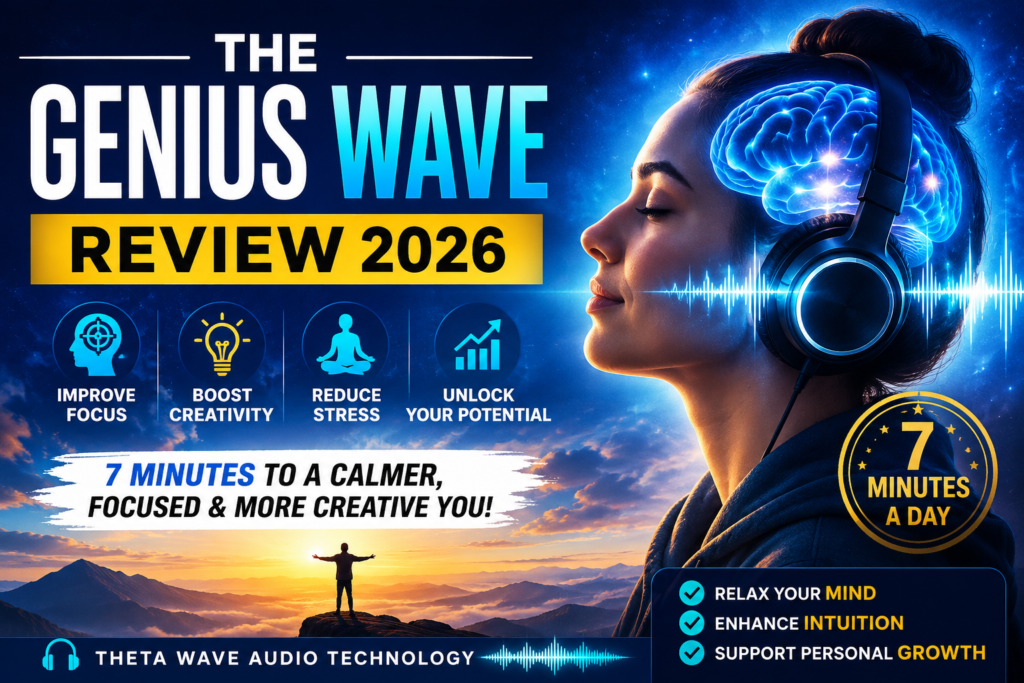
The Genius Wave is marketed as a short digital audio experience that users listen to regularly, typically with headphones. Its promotional concept centers on theta brainwave activity—a pattern commonly discussed in relation to drowsiness, internal attention, memory processing, imagination and certain meditative states.
But what exactly is The Genius Wave? How is it supposed to work? Is it simply relaxing music, or does it offer something different? Can a short audio session genuinely transform someone’s intelligence, finances or life?
This in-depth Genius Wave review explores the program’s concept, claimed benefits, possible limitations, ideal users and practical listening routine. It will also separate realistic personal-development benefits from exaggerated expectations.
The goal is not to promise miraculous results. It is to help you decide whether The Genius Wave could be a useful addition to your meditation, focus or personal-growth routine.
Affiliate disclosure: This article contains an affiliate link. If you purchase through it, the publisher may receive a commission at no additional cost to you.
Table of Contents
What Is The Genius Wave?
The Genius Wave is a downloadable audio-based personal-development program promoted as a simple daily listening practice.
Instead of asking users to complete long lessons, purchase specialized equipment or radically change their lifestyle, the program is built around a brief audio session. Current online descriptions commonly promote a listening period of approximately seven minutes per day, although some older promotional references have mentioned different session lengths. Because digital products can be revised, buyers should confirm the current instructions on the official presentation page before use.
Its central marketing idea is that specific sound patterns may encourage the brain toward a relaxed state associated with theta activity.
The program is often discussed alongside concepts such as:
Brainwave entrainment
Theta-wave meditation
Audio-guided relaxation
Subconscious reprogramming
Visualization
Mental clarity
Creativity
Intuition
Focus
Personal transformation
It is important to understand the distinction between a promotional claim and a medically established outcome.
The Genius Wave is a general wellness and personal-development product. It should not be treated as a medical therapy, psychiatric treatment, intelligence-enhancing drug or guaranteed method of producing financial success.
A more sensible way to view it is as a structured audio ritual—a brief period in which you step away from distractions, relax your attention and direct your mind toward a chosen intention.
That may sound simple, but simplicity is part of the appeal.
Many people struggle to meditate because they do not know where to begin. Others download meditation applications but stop using them because the sessions feel too long. A short audio track can reduce that barrier and make daily consistency easier.
What Are Theta Brainwaves?
To understand the Genius Wave concept, it helps to know what brainwaves are.
The electrical activity of the brain can be observed as oscillating patterns. These patterns are generally categorized by frequency and are often described using names such as delta, theta, alpha, beta and gamma.
Theta activity is commonly placed at approximately four to eight hertz, though definitions can vary slightly depending on the research context.
Theta activity may occur during:
Drowsiness
Early stages of sleep
Memory-related processes
Internal attention
Mind-wandering
Certain contemplative or meditative states
Imaginative thinking
However, the brain is extremely complex. It does not operate in one single frequency at a time, and the presence of a particular brainwave pattern does not automatically produce genius, wealth, photographic memory or supernatural abilities.
This is where marketing language sometimes becomes misleading.
It is reasonable to say that relaxed listening or meditation may help someone create mental space, feel less distracted or approach a problem differently. It is not reasonable to guarantee that merely hearing an audio file will permanently increase intelligence or cause effortless success.
The Genius Wave should therefore be approached as a relaxation and focus tool, not as a magical shortcut.
How Is The Genius Wave Supposed to Work?
The program is promoted around the concept of brainwave entrainment.
Brainwave entrainment refers broadly to the idea that rhythmic sensory stimulation—often sound or light—may encourage neural activity to synchronize, or partially follow, an external rhythm.
Audio approaches may use techniques such as binaural beats, pulsing tones, layered frequencies, ambient sound or rhythmic modulation.
With binaural beats, for example, a slightly different tone is played into each ear. The listener perceives an additional rhythmic difference between the two tones. This is one reason headphones are commonly recommended for binaural-style audio.
The Genius Wave’s public marketing has been described by third-party reviews as using specialized audio intended to encourage a theta-like listening state. However, publicly available descriptions differ regarding the precise technologies used, and promotional claims should not be confused with independently verified product specifications.
The practical process is generally presented as follows:
Find a quiet and comfortable place.
Put on headphones if recommended.
Play the audio.
Close your eyes and relax.
Listen without multitasking.
Repeat the practice consistently.
The audio itself is only one part of the experience.
Your environment, expectations, breathing, emotional state and daily consistency may influence how useful you find the routine.
Someone who listens while checking emails, arguing online and worrying about five different tasks is unlikely to experience the same calm as someone who intentionally sits down, turns off notifications and gives the session full attention.
The Genius Wave and the Subconscious Mind
The subconscious mind is a popular topic in personal-development circles.
People often use the term to describe automatic habits, emotional associations, deeply held beliefs and learned patterns that influence behavior without constant conscious analysis.
For example, you may consciously want to begin a business but repeatedly avoid taking action because you associate visibility with criticism.
You may want to improve your finances while automatically thinking:
“People like me never become successful.”
“Money is always difficult to earn.”
“I am not talented enough.”
“I will probably fail.”
“I do not deserve better opportunities.”
An audio program cannot automatically erase these beliefs.
Nevertheless, a quiet daily practice may give you an opportunity to notice them.
When the external world becomes quieter, internal patterns can become more visible. You may recognize recurring fears, assumptions or self-defeating thoughts that normally operate in the background.
This awareness can become the first step toward change.
Your website already explores how subconscious beliefs may affect behavior, confidence and financial decision-making. For a deeper discussion, read How to Reprogram Subconscious Money Blocks and Transition to Value-Based Pricing. That article emphasizes that mindset work becomes more useful when combined with concrete behavioral and professional strategies.
The same principle applies here.
Listening should not replace action. It can become a mental preparation ritual before action.
Watch This Video
Click the thumbnail below to watch the full video on YouTube.
The Genius Wave Review : Claimed Benefits
The Genius Wave is promoted with a broad range of possible benefits. Depending on the sales presentation or third-party review, these may include improved creativity, concentration, intuition, mental clarity, learning or relaxation.
These claims should be interpreted carefully.
Individual experiences vary, and the existence of research on meditation or auditory stimulation does not automatically prove that one specific commercial recording produces all advertised outcomes.
Still, there are practical ways a short listening ritual might help some users.
1. Creating a Daily Mental Reset
One of the most realistic benefits is simply pausing.
Seven uninterrupted minutes may not sound significant, but it can create a clear boundary between mental chaos and deliberate attention.
A morning listening session could help you avoid immediately entering a reactive state after waking. An afternoon session could help you reset after hours of work. An evening session might help you shift away from constant digital stimulation.
The benefit may come not from a mysterious transformation but from creating a consistent moment of calm.
2. Supporting a Meditation Habit
Meditation can feel difficult for beginners.
People often assume they must completely stop their thoughts. When thoughts continue appearing, they believe they have failed.
In reality, meditation often involves noticing thoughts and repeatedly returning attention to a chosen anchor.
An audio track can provide that anchor.
If you are interested in developing your practice further, read Mastering Mindfulness Meditation, where you can find related content about awareness, meditation and personal transformation. Your website’s Law of Attraction section includes resources on mindfulness, abundance meditation and choosing a meditation instructor.
3. Encouraging Creative Space
Creativity rarely flourishes when every moment is filled with noise.
Writers, entrepreneurs, designers and problem-solvers sometimes discover their best ideas when walking, showering, resting or sitting quietly.
These moments reduce external input and allow ideas to connect more freely.
A short audio session may support creativity by giving the mind permission to pause.
That does not mean the sound creates ideas from nothing. Rather, the listening environment may help you access thoughts that were hidden under distraction.
4. Improving Intention Setting
Many people begin the day with vague goals.
They know they want a better life, more money, stronger relationships or improved health, but they have not defined what that actually means.
A Genius Wave session can be paired with specific intention setting.
Before listening, choose one clear intention:
I will complete the first draft of my article today.
I will contact three potential clients.
I will respond calmly during a difficult conversation.
I will walk for thirty minutes.
I will review my expenses and make one practical financial decision.
I will spend one focused hour learning a valuable skill.
The intention transforms the session from passive listening into preparation for purposeful action.
5. Supporting Visualization
Visualization involves mentally rehearsing an action or outcome.
Athletes may visualize performing a movement correctly. Speakers may imagine presenting confidently. Entrepreneurs may picture themselves handling a meeting calmly and professionally.
Visualization does not guarantee an outcome, but it may help clarify the behaviors required to pursue it.
Your website’s Dr. Joe Dispenza guide discusses visualization, subconscious patterns and mind-body practices within a personal-development framework.
The Genius Wave could be used as background support for a visualization exercise, provided you remain grounded in realistic action.
6. Reducing Digital Distraction
Many people cannot remain away from their phones for seven minutes.
That fact alone reveals the value of an intentional listening routine.
Turning off notifications, closing social media and listening with your eyes closed can interrupt compulsive digital behavior.
The audio may therefore become a daily signal:
“This is the moment when I stop consuming and begin listening inwardly.”
7. Supporting a Positive Morning Routine
Morning habits often shape the emotional tone of the day.
Starting with alarming news, emails and social media can immediately create comparison, urgency or stress.
A calmer routine might include:
Drinking water.
Stretching gently.
Listening to The Genius Wave.
Writing one intention.
Identifying the day’s most important task.
Beginning that task before checking unnecessary notifications.
This routine is not magical. It is practical.
Its value comes from replacing an automatic morning with a deliberate one.
This is the most important question—and the answer depends on what you mean by “work.”
Does it guarantee genius-level intelligence?
No credible audio program can promise that result.
Does it guarantee wealth, success or manifestation?
No. Financial success depends on many factors, including skills, opportunities, planning, decisions, relationships, market conditions, persistence and sometimes circumstances outside an individual’s control.
Does it replace therapy, medical treatment or medication?
No.
Could it help some people relax, focus their attention, establish a meditation habit or mentally prepare for purposeful action?
That is a more realistic possibility.
The experience is subjective. One user may feel deeply relaxed. Another may notice very little. A third may appreciate the routine but not the audio itself.
Some third-party reviews report positive experiences, while online discussions also include skepticism about the program’s advertising and the strength of its claims.
This mixed reaction is normal for self-help products.
The most balanced conclusion is that The Genius Wave may be worth considering as a low-effort personal-development exercise, but it should not be purchased with the expectation of an instant or guaranteed transformation.
The Difference Between Relaxation and Life Transformation
Relaxation can happen quickly.
Life transformation usually cannot.
You may feel calmer after one listening session. You may also experience a temporary sense of motivation or inspiration.
But lasting change requires repeated behavior.
Suppose your goal is to become financially independent.
Listening may help you feel focused, but you still need to:
Increase valuable skills
Manage expenses
Create offers
Find clients or customers
Produce useful content
Build relationships
Evaluate risks
Learn from failure
Improve your strategy
Suppose your goal is better health.
The audio might support relaxation, but you may still need to:
Improve sleep
Eat appropriately
Move regularly
Manage stress
Attend medical appointments
Follow qualified professional advice
Suppose your goal is greater confidence.
Listening may create a positive mental state, but confidence grows through experience. You must still speak, publish, apply, ask, negotiate or take another meaningful step.
Your article Why the Law of Attraction Is Not Working explains a similar principle: positive thinking becomes more effective when paired with deliberate action, patience and consistency.
The Genius Wave should support your actions—not replace them.
Watch My Complete Genius Wave Review
Watch the video below to learn how The Genius Wave works, its potential benefits, limitations, and whether this seven-minute theta audio program may fit your daily routine.
How to Use The Genius Wave Effectively
If you decide to try the program, use it deliberately.
Step 1: Choose a Consistent Time
Pick a time you can realistically maintain.
Good options include:
Shortly after waking
Before beginning focused work
During an afternoon reset
Before visualization or journaling
Before bed, provided the audio does not interfere with your sleep
Consistency is more valuable than choosing the “perfect” hour.
Step 2: Create a Distraction-Free Environment
Place your phone in airplane mode or activate “Do Not Disturb.”
Sit or lie in a safe, comfortable position.
Do not use audio designed for deep relaxation while driving, operating machinery or performing a task that requires full external attention.
Step 3: Use Appropriate Headphones
Follow the product’s current instructions.
Some audio techniques depend on separate left- and right-ear signals, making stereo headphones important. Other audio may work through speakers.
Confirm the recommendation provided with the program.
Keep the volume comfortable. Louder is not necessarily better.
Step 4: Breathe Naturally
Do not force your breathing.
You can begin with a few slow breaths:
Inhale gently.
Exhale slowly.
Relax the jaw.
Lower the shoulders.
Allow the body to settle.
Step 5: Avoid Chasing a Special Sensation
Some listeners become frustrated because they expect tingling, visions, euphoria or an altered state.
You do not need to experience anything dramatic.
Your session may feel deeply calming one day and ordinary the next.
Allow the audio to play without constantly evaluating whether it is “working.”
Step 6: Add a Clear Intention
Before the session, ask:
“What meaningful action will I take after listening?”
Write the answer down.
This makes the routine practical.
Step 7: Take Action Immediately Afterwards
When the session ends, complete a small action related to your intention.
For example:
Open the document and write the first paragraph.
Send the email.
Review the budget.
Put on your walking shoes.
Read five pages.
Practice the skill.
Make the appointment.
Publish the post.
This creates a connection between inner focus and external behavior.
A 21-Day Genius Wave Routine
You can test the program systematically rather than relying on a vague impression.
Days 1–7: Build Consistency
Your only goal during the first week is to listen at approximately the same time each day.
After every session, record:
Your mood before listening
Your mood afterward
Your level of distraction
Whether you completed your chosen action
Do not search for miraculous signs.
Observe.
Days 8–14: Add Visualization
Choose one goal.
During or immediately after listening, imagine yourself completing the behavior associated with that goal.
Avoid visualizing only the final reward.
For example, do not imagine merely receiving money. Visualize yourself creating value, speaking confidently, completing projects, solving problems and making thoughtful decisions.
Days 15–21: Strengthen Action
At the end of every session, take one immediate step.
The step should be small enough to begin within five minutes.
At the end of twenty-one days, ask:
Did I become more consistent?
Did the routine improve my focus?
Did I enjoy the audio?
Did I take more purposeful action?
Did my stress level change?
Would I continue using it?
This approach gives you useful personal evidence.
Using The Genius Wave With Affirmations
Affirmations are positive statements used to direct attention toward constructive beliefs and behaviors.
They work best when they are believable, specific and connected to action.
Weak affirmation:
“I will become infinitely wealthy without effort.”
Stronger affirmation:
“I am learning to recognize and act on valuable opportunities.”
Weak affirmation:
“I never feel afraid.”
Stronger affirmation:
“I can take meaningful action even when I feel uncertain.”
Weak affirmation:
“My life changes instantly.”
Stronger affirmation:
“My daily choices are creating gradual, meaningful change.”
You can repeat an affirmation before or after listening.
Examples include:
I give my full attention to what matters.
I am capable of learning valuable skills.
I create before I consume.
I respond thoughtfully instead of reacting automatically.
I welcome useful ideas and test them through action.
I release perfectionism and begin.
I make decisions that support my long-term goals.
I treat setbacks as information.
I am building a calmer and more disciplined mind.
I follow inspiration with consistent effort.
For more ideas about combining meditation and abundance-oriented thinking, visit Harnessing Abundance Through Meditation. The guide discusses visualization, breathing and affirmations as elements of a structured meditation practice.
The Genius Wave and the Law of Attraction
The Genius Wave attracts interest from Law of Attraction audiences because both topics emphasize attention, belief, emotion and intention.
Law of Attraction teachings often suggest that what you repeatedly focus on influences your decisions, emotional state and perception of opportunities.
A grounded interpretation does not require believing that thoughts alone control every event.
Your focus can influence:
What you notice
How you interpret setbacks
Whether you take action
How consistently you persist
How you communicate
Which opportunities you explore
How you respond to uncertainty
Visualization and meditation may help organize your attention, but action remains necessary.
Your article Unlocking the Secrets of the Law of Attraction discusses positive thinking, visualization and abundance. It also already references The Genius Wave as a possible addition to a meditation strategy.
A balanced Law of Attraction routine might look like this:
Calm the mind.
Identify a meaningful desire.
Define the behavior required.
Visualize completing that behavior.
Notice limiting beliefs.
Replace them with more useful beliefs.
Take action.
Review the result.
Adjust and continue.
Who May Appreciate The Genius Wave?
The program may appeal to people who:
Prefer short audio practices
Struggle with long meditation sessions
Want a structured morning ritual
Enjoy visualization and affirmations
Are interested in theta-wave meditation
Need a regular break from digital distraction
Want to create mental space before focused work
Are curious about brainwave audio
Understand that results vary
Are willing to combine listening with action
It may also appeal to creators, freelancers, students and entrepreneurs who want a clear transition into focused work.
For example, a writer could listen before drafting. A student could use it before a study block. A business owner could listen before reviewing priorities. A speaker could combine it with mental rehearsal before a presentation.
Who Should Avoid Unrealistic Expectations?
The Genius Wave may not suit someone who expects:
Instant wealth
Guaranteed intelligence enhancement
Effortless success
A cure for a medical condition
Permanent memory improvement after one session
Supernatural abilities
A replacement for sleep
A replacement for professional mental-health treatment
Results without behavioral change
Marketing often emphasizes dramatic transformation because dramatic promises attract attention.
Your decision should be based on realistic value:
“Would a brief, structured audio ritual help me relax, focus and become more intentional?”
That is a useful question.
“Will this recording automatically solve every problem in my life?”
That is not.
Potential Advantages
Short Daily Commitment
A brief listening session is easier to maintain than a complicated hour-long routine.
Digital Access
Because the program is delivered digitally, users can generally access it without waiting for a physical shipment.
Beginner-Friendly Format
You do not need advanced meditation experience to listen to audio.
Flexible Routine
It can potentially be used before work, visualization, journaling or rest.
Encourages Intentional Pauses
Even without dramatic effects, deliberately stepping away from distractions can be valuable.
May Complement Existing Practices
It can be combined with meditation, affirmations, journaling and goal setting.
Possible Disadvantages
Marketing May Create Excessive Expectations
Terms such as “genius” can encourage buyers to expect more than an audio program can realistically guarantee.
Results Are Subjective
Not every listener will notice a meaningful difference.
Product-Specific Evidence Is Limited
Research on meditation, relaxation or auditory stimulation should not be treated as direct proof that one commercial track produces every promoted benefit.
Requires Consistency
Purchasing the program without using it regularly is unlikely to produce value.
Listening Does Not Replace Action
The program cannot complete your work, build your business, repair relationships or make decisions for you.
May Not Be Suitable for Everyone
People with neurological conditions, sound sensitivity, epilepsy, severe psychiatric symptoms, hearing concerns or other relevant health issues should consult an appropriate healthcare professional before using brainwave-style audio.
Is The Genius Wave Safe?
For many adults, listening to audio at a comfortable volume is an ordinary activity.
However, general precautions are sensible:
Do not listen while driving.
Do not listen while operating machinery.
Keep the volume moderate.
Stop if you experience discomfort, dizziness, distress or unusual symptoms.
Follow the official instructions.
Seek medical advice when appropriate.
Do not use it as a substitute for prescribed care.
People who are pregnant, have epilepsy, use implanted medical devices, experience seizures, have serious mental-health conditions or are under medical supervision should consult a qualified professional before using brainwave-entrainment products.
This article provides general educational information and is not medical advice.
Frequently Asked Questions
Is The Genius Wave a meditation?
It can be used as part of a meditation routine, but it is primarily marketed as an audio program. Your experience will depend on how you use it.
How long is The Genius Wave audio?
Current third-party descriptions commonly mention a short session of approximately seven minutes, although older online pages may cite other durations. Confirm the exact length and usage instructions on the current product page.
Do I need headphones?
Headphones may be recommended if the audio uses stereo separation or binaural-style techniques. Follow the instructions included with the current product.
Can The Genius Wave make me smarter?
No audio should be expected to produce guaranteed intelligence enhancement. It may be more realistic to use it as a focus, relaxation or intention-setting tool.
Can it help with creativity?
A quiet listening routine may create space for reflection and ideas, but creativity still depends on knowledge, curiosity, practice and effort.
Does The Genius Wave help manifestation?
It may complement visualization, affirmations and intention setting. It cannot guarantee that desires will manifest without action or regardless of circumstances.
Can I listen while working?
You may gain more from the program by listening without multitasking. If the track encourages deep relaxation, avoid using it during tasks requiring full attention.
When is the best time to listen?
Morning, before focused work or during a quiet afternoon break may be practical. The best time is one you can maintain consistently and safely.
How quickly will I notice results?
Some people may feel relaxed during the first session. Other outcomes, such as improved consistency or focus, should be evaluated over time. Individual experiences vary.
Is The Genius Wave a medical treatment?
No. It is a digital personal-development and wellness product, not a treatment for neurological, psychiatric or medical conditions.
Where can I access The Genius Wave?
Use the authorized presentation linked below to review the current offer, instructions, pricing and policies.
The Genius Wave is best understood as a short audio-based personal-development practice—not a guaranteed path to genius, wealth or extraordinary powers.
Its strongest potential value lies in its simplicity.
It creates a reason to stop, close your eyes, step away from digital noise and spend a few minutes focusing inwardly.
For someone who has struggled to maintain a meditation routine, that simplicity may be useful.
For someone who enjoys visualization, affirmations and Law of Attraction practices, the audio may provide a structured background for those exercises.
For a writer, student, creator or entrepreneur, it may serve as a transition into focused work.
However, the program should be combined with realistic expectations.
The audio cannot replace learning, planning, discipline, sleep, medical care or action. It cannot guarantee intelligence, financial abundance or personal transformation.
The most productive approach is to use the session as a trigger:
Listen. Reflect. Choose. Act.
That four-step process turns the program from passive entertainment into a potentially meaningful daily ritual.
The question is therefore not whether a sound file can magically transform your life.
The better question is:
“Can this brief daily practice help me become calmer, more intentional and more consistent with the actions that matter?”
For some users, the answer may be yes.
Start Your Genius Wave Routine
You do not need to redesign your entire life overnight.
Begin with a few quiet minutes. Choose one clear intention. Listen carefully. Then take one meaningful step.
Click below to watch the complete presentation and discover what The Genius Wave currently includes:
Individual results vary. The Genius Wave is intended for general personal-development and wellness purposes. It is not designed to diagnose, treat, cure or prevent disease and does not guarantee cognitive, financial or personal outcomes.
Related Reading
Continue exploring mindset, meditation and personal transformation through these resources:
This article contains affiliate links. If you purchase a product through one of these links, the website owner may receive a commission at no additional cost to you.
The information provided in this article is for general educational and informational purposes only. Statements about The Genius Wave describe the program’s promotional positioning and should not be interpreted as independently proven medical or scientific outcomes. No result is guaranteed.
The product and this article are not intended to diagnose, treat, cure or prevent any illness. Consult a qualified healthcare professional before using brainwave audio if you have epilepsy, seizures, a neurological condition, significant sound sensitivity, an implanted medical device, a serious mental-health condition or other health concerns.