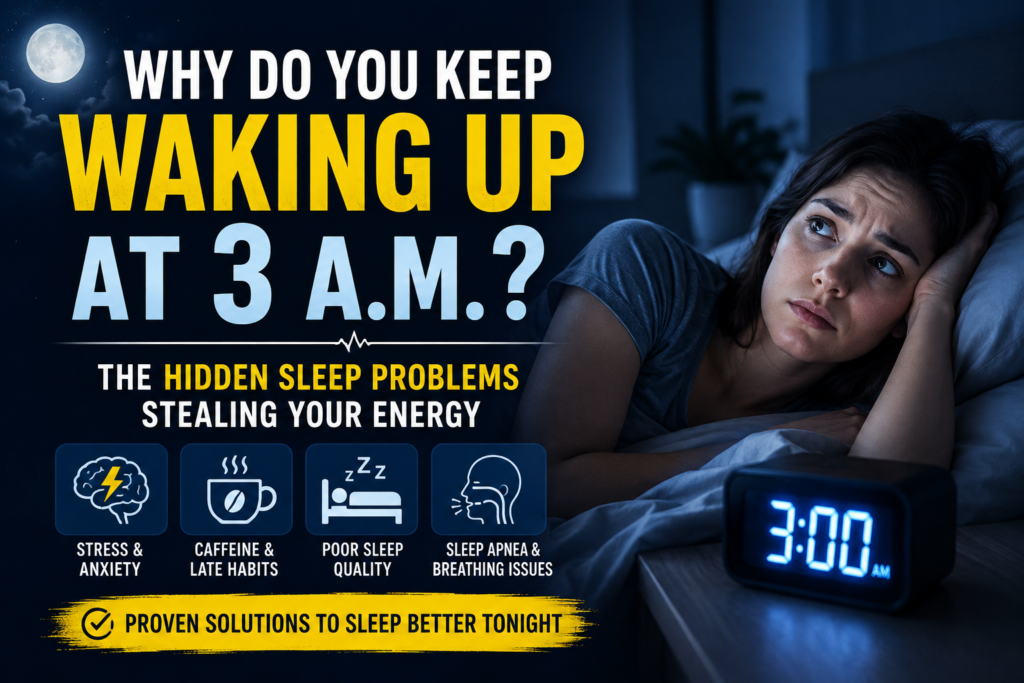
Why do I keep waking up at 3 a.m.? If you ask yourself this question night after night, stress, caffeine, poor sleep habits, or an underlying sleep problem may be disrupting your rest.
Problems Stealing Your Energy
Affiliate disclosure: This article “why do I keep waking up at 3 am” contains affiliate links. If you purchase through one of these links, we may earn a commission at no additional cost to you. This does not affect the information presented in this article.
It is 3:07 in the morning. Your bedroom is quiet, the lights are off, and everyone else seems to be sleeping peacefully. Yet your eyes are wide open.
You turn your pillow over. You change sleeping positions. You check the clock and immediately regret it. Then your mind begins calculating how many hours remain before morning.
Why do I keep waking up at 3 AM?
For many adults, this is not an occasional inconvenience. It becomes a nightly pattern that leaves them exhausted, frustrated, and worried about the next day.
You may fall asleep without difficulty but suddenly wake up three or four hours later. Sometimes your mind starts racing. Sometimes you feel hot, tense, thirsty, uncomfortable, or unusually alert. On other nights, you wake up without understanding why.
This type of sleep problem is often called sleep-maintenance insomnia, meaning that you can fall asleep but have difficulty remaining asleep. Insomnia can also involve trouble falling asleep, waking earlier than intended, or getting sleep that does not feel restorative.
Nighttime awakenings may be associated with stress, caffeine, alcohol, an irregular sleep schedule, environmental disturbances, physical discomfort, medication, sleep anxiety, or an underlying sleep disorder.
The encouraging news is that you do not have to treat poor sleep as an unavoidable part of life. Once you understand what may be interrupting your sleep, you can begin making changes that support deeper and more consistent rest.
Table of Contents
Why Is Quality Sleep So Important?
Sleep is not simply a period when the body becomes inactive. It supports memory, emotional regulation, concentration, physical recovery, metabolism, immune function, and the ability to perform everyday activities safely.
Most adults between 18 and 60 years old are advised to get at least seven hours of sleep per day. However, total sleep time is only one part of healthy sleep. Continuity, timing, regularity, and how refreshed you feel in the morning also matter.
You can spend eight hours in bed and still wake up exhausted if your sleep is repeatedly interrupted.
Common signs of poor sleep quality include:
- Waking up several times during the night
- Struggling to fall asleep again
- Feeling unrefreshed in the morning
- Experiencing headaches after waking
- Depending heavily on caffeine
- Feeling irritable or emotionally sensitive
- Having difficulty concentrating
- Experiencing afternoon energy crashes
- Feeling sleepy while driving or working
- Worrying about sleep throughout the day
Insufficient or disrupted sleep can interfere with attention, memory, mood, reaction time, work performance, and daily functioning. Persistent sleep difficulties deserve attention, especially when they affect your safety or quality of life.
Why Do I Keep Waking Up at 3 AM Every Night?
There is no universal meaning behind waking at exactly 3 AM.
The time itself is usually less important than the pattern. If you regularly wake after three or four hours of sleep, something may be interrupting your natural sleep cycle or increasing your level of alertness.
Possible causes of ” why do I keep waking up at 3 am” include:
- Stress and racing thoughts
- An inconsistent bedtime
- Caffeine consumed too late
- Alcohol before bed
- Noise, heat, or light
- Phone use during the night
- Chronic pain or acid reflux
- Frequent nighttime urination
- Hormonal changes
- Medication side effects
- Restless legs
- Sleep apnea
- Conditioned sleep anxiety
Several factors may occur together. For example, stress may make your sleep lighter, while caffeine and phone use make it harder to fall asleep again.
Keeping a record of your routine can help you identify which factors are most relevant to you.
1. Stress May Be Following You Into Bed
When people ask, “Why do I keep waking up at 3 AM ?”, stress and nighttime anxiety are often among the first factors to examine.
During the day, work, conversations, errands, and responsibilities may distract you from your worries. At night, those distractions disappear.
Your mind finally has enough silence to process everything you have postponed.
You may begin thinking about:
- Financial pressure
- Work deadlines
- Family responsibilities
- Relationship problems
- Health concerns
- Unfinished tasks
- Past conversations
- Tomorrow’s obligations
Your body may feel tired while your mind remains in problem-solving mode.
This can create a difficult cycle: you worry because you are not sleeping, and your worry makes it even harder to return to sleep.
What may help
Before bed, spend five minutes writing down your worries and tomorrow’s priorities. The purpose is not to solve every problem at night. It is to reassure your mind that the information has been recorded.
Slow breathing, gentle stretching, quiet reading, or guided meditation may also help create a transition between daytime activity and sleep.
Readers who prefer structured guidance can explore this guide to choosing the right meditation instructor. It explains guided meditation, mindfulness practices, individual sessions, and group instruction.
You may also find useful relaxation ideas in this guide to harnessing abundance through meditation, including breathing, visualization, mindfulness, and meditation routines.
Meditation can support relaxation, but it should complement rather than replace professional treatment when anxiety or insomnia is persistent.
2. Your Sleep Schedule May Be Confusing Your Body Clock
Your body generally responds better to consistency than to dramatic changes in bedtime.
Imagine this pattern:
- You go to bed at 10:30 PM during the week.
- You stay awake until 2 AM on Friday and Saturday.
- You sleep late on Sunday morning.
- You try to return to an early bedtime on Sunday night.
Although you may be spending enough time in bed, your internal sleep-wake rhythm is being asked to adjust repeatedly.
Shift work, travel, late-night entertainment, irregular meals, and long afternoon naps can create similar problems.
What may help
Choose a realistic wake-up time and keep it relatively consistent, including on weekends.
A consistent morning routine can strengthen your body’s expectation of when to become awake and when to become sleepy.
Morning daylight, regular meals, and daytime physical activity may also support a more stable routine.
Do not attempt to create a perfect schedule that you cannot maintain. A simple routine followed consistently is more valuable than an ambitious routine followed for only two nights.
3. Caffeine May Be Affecting You Longer Than You Think
If you keep wondering, “Why do I keep waking up at 3 AM?”, consider whether afternoon coffee, energy drinks, or late-night chocolate may be affecting your sleep.
Some people believe caffeine is not a problem because they can still fall asleep after drinking coffee. However, falling asleep does not always mean that sleep quality and continuity are unaffected.
Caffeine may be present in:
- Coffee
- Espresso
- Black tea
- Green tea
- Energy drinks
- Cola
- Chocolate
- Pre-workout products
- Some headache medications
- Certain weight-management products
People differ significantly in how quickly they process caffeine. A drink that does not affect one person may disrupt another person’s sleep several hours later.
Try a caffeine experiment
For ten to fourteen days:
- Avoid caffeine late in the afternoon and evening.
- Record when you go to bed.
- Record how many times you wake up.
- Note how refreshed you feel in the morning.
- Compare the results with your previous routine.
This simple experiment may provide more useful information than guessing.
4. Alcohol Can Make You Sleepy Without Producing Restful Sleep
Alcohol may initially make you feel relaxed or drowsy. This is why some people use it as a nighttime sleep aid.
However, feeling sleepy is not the same as obtaining continuous and restorative sleep.
As alcohol is processed during the night, some people experience:
- More frequent awakenings
- Sweating
- Thirst
- Headaches
- Snoring
- Vivid dreams
- Early-morning alertness
- A need to use the bathroom
- Difficulty falling asleep again
Using alcohol as a regular insomnia treatment can also hide the original cause of your sleep difficulty.
Try reducing or avoiding alcohol near bedtime and observe whether the second half of your night becomes less fragmented.
5. Your Phone May Be Training Your Brain to Stay Alert
The problem with nighttime phone use is not limited to screen brightness.
Your phone gives you immediate access to:
- Work emails
- Social media
- Financial news
- Messages
- Videos
- Games
- Shopping
- Notifications
- Emotionally stimulating stories
Each item gives your brain another reason to remain engaged.
Checking the time at 3 AM can also increase pressure. You may begin calculating how many hours remain before your alarm, which can turn a normal awakening into an anxiety-producing event.
Create a phone boundary
Try charging your phone away from the bed.
When possible, use a traditional alarm clock and establish a screen-free transition period before sleeping. Begin with 20 or 30 minutes rather than demanding an unrealistic two-hour digital detox.
If you wake during the night, avoid opening messages, news, work applications, or social media.
The objective is to teach your brain that the bedroom is associated with rest rather than stimulation.
6. Your Bedroom Environment May Be Interrupting Your Sleep
Your bedroom environment may help explain why you keep waking up at 3 AM, especially when noise, heat, light, or phone notifications interrupt your rest.
Common environmental problems include:
- Street noise
- Loud neighbors
- A television playing nearby
- A bedroom that is too warm
- Outdoor lighting
- Bright alarm clocks
- Phone notifications
- An uncomfortable mattress
- Pets moving during the night
- A partner who snores
- Dry or poorly ventilated air
You do not need an expensive bedroom renovation to test environmental changes.
Try one adjustment at a time:
- Install blackout curtains.
- Use a comfortable sleep mask.
- Try earplugs or gentle background noise.
- Keep the room comfortably cool.
- Turn off unnecessary electronic lights.
- Adjust pillows and bedding.
- Move the phone away from the bed.
- Discuss severe snoring with your partner.
Testing one variable for several nights makes it easier to determine what actually helps.
7. Sleep Anxiety May Be Keeping You Awake
Sleep anxiety develops when sleep itself becomes a source of fear and pressure.
You may begin asking:
- “Am I falling asleep yet?”
- “How many hours do I have left?”
- “Will tomorrow be ruined?”
- “Why is my heart beating so loudly?”
- “What if this happens every night?”
The more aggressively you try to force sleep, the more alert you may become.
After several bad nights, the anxiety may begin before bedtime. Your bedroom becomes associated with frustration, effort, and failure instead of rest.
This pattern is one reason why the advice to “just relax” often feels unhelpful.
Relaxation cannot always be commanded. It is usually supported through repeated habits, reduced pressure, and healthier associations with the bed.
Mindfulness and journaling may help you observe recurring thoughts without automatically treating them as facts. This article on common mindset obstacles and limiting beliefs includes self-reflection and journaling strategies that may be adapted to nighttime worry.
However, persistent sleep anxiety may respond better to a structured insomnia treatment such as cognitive behavioral therapy for insomnia.
8. Sleep Apnea Could Be Interrupting Your Breathing
Anyone asking, “Why do I keep waking up at 3 AM?”, should also pay attention to loud snoring, gasping, morning headaches, and excessive daytime sleepiness.
Sleep apnea is a disorder in which breathing repeatedly stops or becomes very shallow during sleep. In obstructive sleep apnea, the airway becomes narrowed or blocked, and normal breathing may restart with a snort, choking sound, or gasp.
Warning signs may include:
- Loud and frequent snoring
- Gasping or choking during sleep
- Breathing pauses noticed by another person
- Dry mouth in the morning
- Morning headaches
- Waking up unrefreshed
- Difficulty concentrating
- Irritability
- Excessive daytime sleepiness
- Falling asleep while reading or watching television
- Feeling sleepy while driving
Not everyone who snores has sleep apnea, and some people with sleep apnea may not recognize their nighttime symptoms.
A healthcare professional may recommend a sleep apnea test or sleep study. A sleep study records information about breathing, oxygen levels, sleep stages, heart rate, and sleep efficiency.
Do not rely on a supplement or general sleep advice when you experience gasping, choking, breathing pauses, or dangerous daytime sleepiness.
9. Pain, Reflux, Hormonal Changes, or Nighttime Urination May Be Involved
Not every sleep problem begins in the mind.
Physical discomfort can repeatedly interrupt sleep, even when you do not remember every awakening.
Possible contributors include:
- Chronic back or joint pain
- Neck pain
- Headaches
- Acid reflux
- Nasal congestion
- Asthma or breathing difficulty
- Hot flashes
- Night sweats
- Frequent urination
- Pregnancy-related discomfort
- Restless legs
- Skin irritation
- An uncomfortable sleeping position
Treating only the symptom of wakefulness may not help when the underlying problem is pain, reflux, breathing difficulty, or another physical condition.
Notice what you feel when you awaken. Are you hot, thirsty, congested, uncomfortable, short of breath, or experiencing pain?
These details may help a healthcare professional identify the cause.
10. Medication or Supplements May Affect Your Sleep
Some prescription and over-the-counter products may influence alertness, urination, breathing, dreams, or sleep timing.
Do not stop prescribed medication without speaking to the professional who prescribed it.
Instead, ask a doctor or pharmacist whether:
- The medicine could interfere with sleep
- The dose timing could be adjusted
- Another medication may be more suitable
- It interacts with caffeine, alcohol, or supplements
- It could increase nighttime urination
- It could worsen breathing problems
Even products labeled “natural” can cause side effects or interact with medication. Natural does not automatically mean risk-free.
11. You May Be Spending Too Much Time Awake in Bed
When people become desperate for more sleep, they often go to bed earlier and remain in bed longer.
Although this feels logical, it can unintentionally train the brain to associate the bed with wakefulness.
You may begin using your bed for:
- Watching television
- Scrolling on your phone
- Answering emails
- Thinking about problems
- Checking the clock
- Eating
- Working
- Trying intensely to sleep
Over time, getting into bed may no longer produce a strong sleep signal.
When you have been awake for a while and feel increasingly frustrated, consider leaving the bed temporarily. Keep the lighting low and do something quiet until sleepiness returns.
Avoid turning the awakening into an opportunity to work, clean, shop, or consume stimulating content.
How to Stop Waking Up at 3 AM Naturally
Understanding why you keep waking up at 3 AM makes it easier to create a nighttime routine that addresses the cause rather than simply masking the symptoms.
You do not need to change everything tonight. Choose several realistic habits and repeat them consistently.
In the morning
Wake at approximately the same time each day.
Open the curtains or spend time in natural morning light. Avoid remaining in bed for hours after a difficult night unless you are ill or have been advised otherwise by a healthcare professional.
Record how you slept without judging the entire day based on one night.
During the afternoon
Limit late caffeine and avoid long naps when they interfere with nighttime sleep.
Include physical activity in your day when it is appropriate for your health. Complete demanding work earlier when possible so your brain has time to transition before bed.
Three hours before bed
Finish heavy meals when practical.
Reduce alcohol and avoid emotionally intense work discussions. Begin lowering stimulation instead of moving directly from maximum activity to sleep.
Two hours before bed
Dim unnecessary lighting.
Prepare clothing, work materials, meals, or other items needed the next morning. This can reduce the temptation to mentally rehearse tomorrow’s tasks in bed.
One hour before bed
Choose calming activities such as:
- Reading a physical book
- Taking a warm shower
- Gentle stretching
- Writing in a journal
- Listening to quiet audio
- Practicing slow breathing
- Following a short guided meditation
You can browse additional meditation and mindset content in the website’s Law of Attraction resource library.
Thirty minutes before bed
Move your phone away from the bed.
Make the bedroom dark, quiet, and comfortable. Avoid repeatedly checking the clock.
When you wake at 3 AM
Do not immediately conclude that the entire night is ruined.
Avoid opening social media, checking work emails, or calculating your remaining sleep minute by minute.
Relax your jaw and shoulders. Take slow, comfortable breaths without forcing them. If you remain awake and increasingly frustrated, move to a quiet location with low lighting and return to bed when sleepiness returns.
Keep a Two-Week Sleep Diary
Memory becomes unreliable when you are tired. A sleep diary provides more useful information than trying to remember how every night felt.
For approximately two weeks, record:
- Bedtime
- Estimated time needed to fall asleep
- Number of awakenings
- Length of awakenings
- Morning wake time
- Naps
- Caffeine
- Alcohol
- Exercise
- Medication
- Stress level
- Daytime sleepiness
- How refreshed you felt
The NHLBI sleep diary is designed to track sleep quantity, sleep quality, medication, alcohol, caffeine, and daytime sleepiness. The information can then be reviewed with a healthcare professional.
Patterns may become visible after several days.
For example, you may discover that your awakenings are more common after late coffee, alcohol, heavy meals, stressful workdays, long naps, or nights spent using your phone in bed.
What Is the Best Insomnia Treatment?
The best insomnia treatment depends on the cause, duration, severity, and presence of other medical or psychological conditions.
For long-term insomnia, cognitive behavioral therapy for insomnia, commonly called CBT-I, is generally recommended as a first treatment option.
CBT-I is usually delivered over several weeks and addresses both sleep habits and unhelpful beliefs about sleep. It may include:
- Sleep scheduling
- Stimulus-control techniques
- Relaxation training
- Cognitive restructuring
- Managing sleep anxiety
- Adjusting time spent in bed
- Building more consistent routines
The NHLBI describes CBT-I as a six- to eight-week treatment plan that helps people fall asleep faster and stay asleep longer. It can be delivered in person, by telephone, or online by a trained professional.
A professional evaluation may also identify conditions such as:
- Sleep apnea
- Restless legs syndrome
- Depression
- Anxiety disorders
- Chronic pain
- Reflux
- Circadian rhythm disorders
- Medication-related sleep problems
Searching for the “best sleep aid” without first understanding the cause may lead to temporary relief while the underlying problem remains untreated.
Can Natural Sleep Support Be Part of Your Routine?
Many adults explore a natural sleep aid, sleep supplement, herbal formula, or nighttime wellness product while improving their habits.
A supplement may be one part of a broader routine, but it should not be described as a guaranteed cure for chronic insomnia.
Before using any sleep-support product:
- Review the full ingredient list.
- Follow the manufacturer’s directions.
- Check for allergies.
- Review possible side effects.
- Consider medication interactions.
- Speak with a professional during pregnancy or breastfeeding.
- Seek medical advice when you have a chronic condition.
- Never combine products in a way that causes dangerous sedation.
- Do not drive when a product makes you drowsy.
YuSleep is presented as a nighttime sleep-support option for adults who want to explore an additional component for their evening wellness routine.
Explore the Official YuSleep Presentation
Purchasing through this link may generate a commission for the publisher at no additional cost to you. Results vary, and the product should not replace professional diagnosis or treatment.
When Should You Speak With a Healthcare Professional?
Consider seeking professional advice when:
- Sleep problems continue for several weeks
- You regularly feel exhausted despite enough time in bed
- You snore loudly
- You wake up choking or gasping
- Someone notices pauses in your breathing
- You experience morning headaches
- You fall asleep unintentionally during the day
- Drowsiness affects your driving
- Pain or breathing problems wake you frequently
- Sleep difficulty began after starting medication
- Anxiety or low mood is becoming difficult to manage
- Your sleep problems interfere with work or relationships
Excessive daytime sleepiness can be dangerous, particularly when driving or operating machinery.
Do not wait for a dashboard warning from your body. Persistent symptoms are already a reason to seek evaluation.
Frequently Asked Questions
Why do I keep waking up at 3 AM even when I go to bed early?
Going to bed early does not guarantee uninterrupted sleep. Stress, caffeine, alcohol, pain, environmental disturbances, sleep apnea, an inconsistent schedule, medication, or sleep anxiety may still cause awakenings.
Going to bed much earlier than your natural sleep time may also increase the amount of time you spend awake in bed.
Is waking up at 3 AM always caused by anxiety?
No. Anxiety is one possible cause, but physical discomfort, reflux, temperature, noise, alcohol, caffeine, hormonal changes, nighttime urination, medication, restless legs, and breathing disorders may also contribute.
Why do I wake up after four hours of sleep?
You may be experiencing sleep-maintenance insomnia, environmental disruption, stress-related alertness, discomfort, or a sleep disorder. The timing alone cannot determine the cause.
Track your routine and discuss persistent symptoms with a qualified professional.
Why do I wake up tired after eight hours in bed?
Time in bed is not the same as time spent sleeping.
Repeated awakenings, sleep apnea, low sleep efficiency, discomfort, an irregular schedule, or poor sleep quality may leave you tired despite spending eight hours in bed.
Should I stay in bed when I cannot fall asleep again?
Remaining in bed while becoming increasingly frustrated can strengthen the association between the bed and wakefulness.
Consider moving temporarily to a quiet, dimly lit area and returning when you feel sleepy. Avoid work, bright screens, and stimulating entertainment.
Can a natural sleep aid cure chronic insomnia?
A supplement should not be presented as a guaranteed cure.
Chronic insomnia may require professional evaluation and evidence-based treatment such as CBT-I. Supplements may also cause side effects or interact with medication.
How can I stop racing thoughts at night?
Write down tomorrow’s tasks before bed, reduce stimulating content, avoid checking the time repeatedly, and practice slow breathing or guided relaxation.
Persistent nighttime anxiety may benefit from professional support.
How long should I track my sleep?
A two-week record can reveal patterns involving caffeine, alcohol, naps, stress, medication, and awakenings.
Bring your sleep diary to a medical appointment when symptoms are persistent.
Is it normal to wake briefly during the night?
Brief awakenings can occur and may not always be remembered. The issue becomes more concerning when awakenings are frequent, prolonged, distressing, or associated with severe daytime symptoms.
What are the warning signs of sleep apnea?
Common warning signs include loud snoring, gasping, choking, observed pauses in breathing, morning headaches, dry mouth, unrefreshing sleep, difficulty concentrating, and excessive daytime sleepiness.
Final Thoughts
The answer to “Why do I keep waking up at 3 AM?” may involve stress, caffeine, alcohol, sleep anxiety, environmental disturbances, physical discomfort, medication, or an underlying sleep disorder.
The solution is rarely to force yourself to sleep harder.
A more effective approach is to:
- Observe your habits
- Maintain a consistent schedule
- Reduce evening stimulation
- Improve your bedroom environment
- Limit late caffeine and alcohol
- Record your sleep patterns
- Address physical symptoms
- Seek professional care when warning signs appear
Small changes may not create a perfect night immediately. Their value comes from consistency.
Begin tonight with one realistic action. Move your phone away from the bed, write down tomorrow’s tasks, reduce late caffeine, darken your room, or start a sleep diary.
You can also review whether a natural sleep-support product fits into your broader nighttime routine.
If You Ask why do I keep waking up at 3 am? YuSleep Can Give You The Best Answer.
Learn more about YuSleep and view the current official offer here.
Your goal should not simply be to spend more hours in bed.
Your goal is to wake up feeling restored, focused, and prepared for the day.
Medical and Affiliate Disclaimer
This article “why do I keep waking up at 3 am” is provided for general educational purposes only. It does not provide medical advice, diagnosis, or treatment.
Consult a qualified healthcare professional regarding persistent insomnia, breathing interruptions, severe daytime sleepiness, mental-health concerns, medication interactions, pregnancy, or other health conditions.
This article “why do I keep waking up at 3 am” contains affiliate links. The publisher may receive a commission when a purchase is made through an affiliate link, at no additional cost to the buyer. Product ingredients, pricing, availability, guarantees, and terms may change. Review the current information on the official product website before purchasing.